
10 Adventist Doctrines The Songs Sing, Miss, Or Leave Thin
A closer look at what 295 Cebuano Adventist songs sing strongly, what they barely touch, and why some doctrines remain mostly unsung.
The strongest doctrinal area by the coverage pass: God, Lord, Father, holiness, and divine power.
Explicit return-language appears often enough to shape the corpus, but not as often as heaven-language.
Christ's heavenly ministry is nearly absent from the sung vocabulary by this keyword lens.
The Corpus Sings A Center, Not A System
If we compare the 295-song corpus with the wider map of Adventist theology, the first answer is simple: no, the corpus does not cover all of Adventist theology. It is not a sung version of the 28 Fundamental Beliefs.
But that answer is too small by itself. The more important finding is that the corpus clearly sings a recognizable Adventist center. It returns again and again to God, Jesus, heaven, suffering, salvation, faith, readiness, and the hope that Christ will return.
So the question is not whether the songs are Adventist or not. They are. The better question is: which parts of Adventist theology have become singable in this community, and which parts remain unsung?
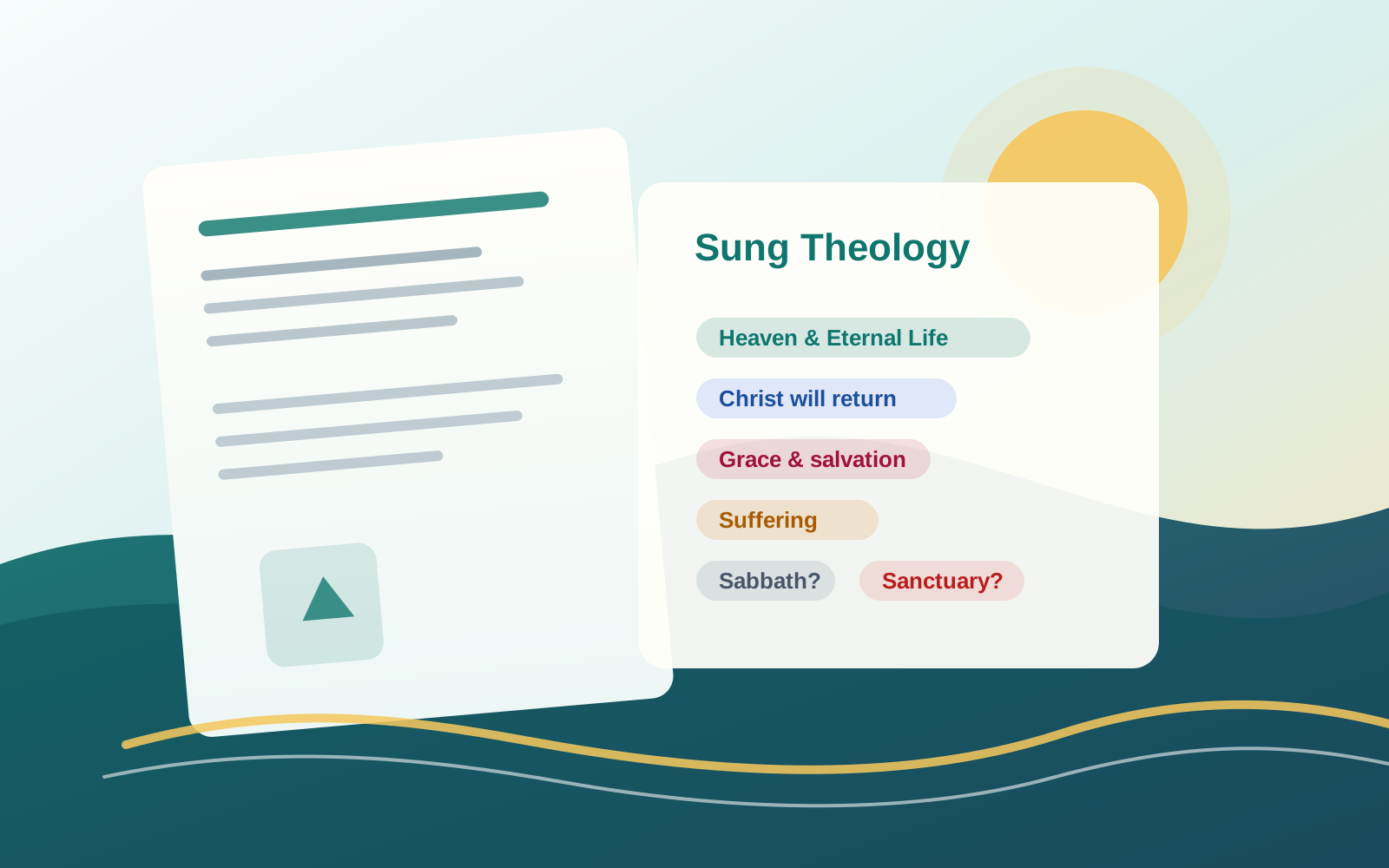
What The Songs Cover Well
The strongest theological signals are broad but meaningful. God or divine-character language appears in 71.9% of songs. Jesus or Christology appears in 61%. Christian life and holiness appear in 49.5%. These are not minor findings. They show that the corpus is deeply concerned with God, Christ, faithfulness, and the moral shape of life.
Heaven and New Earth language appears in 28.1% by the doctrine-coverage pass, while the broader theme analysis shows Heaven and Eternal Life in 65.8%. That difference matters. It means heaven is not only a doctrinal category in the songs; it is also an emotional atmosphere, a destination, a comfort, and a repeated answer to suffering.
Salvation and grace appear in 22.7%, and explicit Second Coming language appears in 17.3%. The songs may not always develop these doctrines deeply, but they clearly know the basic Adventist direction: the present world is fragile, Christ is coming, salvation matters, and the faithful live toward a promised home.
Doctrine coverage
The corpus sings a center, not a full system.
What Is Thin Or Missing
The missing areas are just as revealing. Sabbath appears in only about 1% of the corpus by direct keyword count. The sanctuary and Christ's heavenly ministry appear in only 0.3%. Judgment appears in 3.4%. Prayer appears in 3.7%. Health and body-temple language appears in 2.7%. The Lord's Supper, baptism, spiritual gifts, and other doctrinal areas are also barely visible.
This does not mean the songwriters reject those doctrines. Absence in a worship corpus is not the same as denial. But it does mean those doctrines have not become a strong part of the community's songwriting vocabulary.
The sharpest finding is this: Adventist hope is sung far more often than Adventist systematics. The songs preserve the destination, but many doctrines that explain the journey receive little lyrical attention.
Thin or missing
Some Adventist doctrines remain mostly unsung.
The absence is not always denial. Often it is a sign of what the community has not yet learned to lyricize.
Sabbath
1.0%Usually named as a day, rarely developed as rest, creation, delight, or liberation.
Sanctuary
0.3%Christ's heavenly ministry is almost completely outside the sung vocabulary.
Judgment
3.4%When present, it leans warning more than restoration or God setting things right.
Prayer
3.7%Surprisingly thin for a worship corpus; prayer appears more as request than as a full spiritual life.
Health / Body
2.7%The body-as-temple thread is barely visible.
Three Angels / Mission
15.3%Mission appears, but the distinctive Adventist prophetic frame is mostly implicit.
The Difference Between Sung And Unsung Theology
A doctrine can be believed, preached, and taught without being sung often. Songs are selective. They carry what a community reaches for emotionally, not everything it could confess doctrinally.
In this corpus, heaven is sung as home, comfort, reunion, reward, escape from pain, and final healing. But the New Earth is less often imagined as restored creation. Christ's return is sung, but Christ's present heavenly ministry is almost absent. Obedience is sung, but law and grace are not always held together with theological care.
This is why the corpus should be read as sung spirituality, not as a complete doctrinal curriculum. It reveals what Adventist theology sounds like when filtered through grief, hope, evangelistic appeal, testimony, and congregational memory.
Sung and unsung
The issue is not false theology. It is partial theology.
Heaven as home
New Earth as restored creation
Christ will return
Christ's present heavenly ministry
Keep believing
How Sabbath forms tired bodies
Obey God's commands
Law and grace held together deeply
Judgment is coming
Judgment as healing justice
Why Might These Doctrines Be Missing?
The first reason is pastoral need. Songs often arise where people hurt. A suffering community reaches quickly for comfort, heaven, faith, God's love, and Christ's return. These themes are not shallow simply because they repeat. They are survival language.
The second reason is craft difficulty. Some doctrines are harder to lyricize. The sanctuary, investigative judgment, the state of the dead, the remnant, health, and the three angels' messages require careful language. Without poetic imagination, they can become technical, preachy, or emotionally flat.
The third reason is public worship safety. Broad Christian language travels more easily than denominationally dense language. A song about God's love can be sung almost anywhere. A song about Christ's heavenly mediation or the investigative judgment requires more confidence, formation, and theological precision.
The fourth reason is formation. The study's critique data shows low averages in Show vs Tell, Metaphor Quality, Theological Depth, and Originality. That suggests many writers know the conclusion of Adventist belief, but may not yet have a wide enough biblical and poetic vocabulary to make the less familiar doctrines sing.
Why the gaps appear
Missing doctrine usually has social and artistic causes.
Songs answer felt need
A grieving or tired church reaches first for heaven, comfort, and endurance.
Some doctrines are hard to sing
Sanctuary, judgment, and remnant identity require careful poetic translation.
Public worship rewards safer language
Broad Christian phrases travel more easily than denominationally dense ones.
Formation shapes imagination
Low theological-depth and show-vs-tell scores suggest inherited conclusions need richer language.
What This Reveals About Cebuano Adventist Songwriting
The corpus is not theologically empty. It is theologically concentrated. It has a strong center: God is good, Jesus saves, life is hard, heaven is real, Christ will return, and believers must endure.
But concentration has a cost. If the same center is sung through the same limited vocabulary, the tradition can become emotionally faithful but theologically narrow. A church may keep singing true things while leaving much of its theological inheritance outside the song.
The opportunity is not to force every doctrine into every song. That would produce stiff music. The opportunity is to help songwriters find natural, beautiful, Cebuano ways to sing more of the Adventist story: Sabbath as rest for tired bodies, judgment as God setting things right, the sanctuary as Christ's nearness and advocacy, the state of the dead as hope at the grave, mission as love moving toward the neighbor.
“The corpus is not theologically empty. It is theologically concentrated.”
A More Generous Reading
A shallow reading would say, 'The songs do not cover all Adventist theology, therefore they are weak.' A better reading says, 'The songs show us which doctrines have become emotionally available to the community, and which doctrines still need a language of beauty.'
That is a hopeful finding. The songs already preserve the Blessed Hope. They already carry faith through suffering. They already teach people to look beyond the present world. What they need is not a new center, but a larger language around that center.
The next generation of Cebuano Adventist songwriting can keep heaven, keep hope, keep Christ's return, and still become more richly Adventist. The corpus has taught the church where it is going. Now the work is to sing more of the road, more of the Guide, and more of the theology that makes the hope so durable.