
169 Songs Name Pain, But Hope Still Wins
What the word cloud reveals about suffering, endurance, and the emotional theology of Bisaya Adventist worship songs.
A corpus large enough to show shared vocabulary rather than one writer's habits.
At least 169 songs contain a suffering, sin, death, pain, or anxiety term.
Positive word coverage in the top 100 is about four times larger than negative coverage.
A Cloud That Looks Like Theology
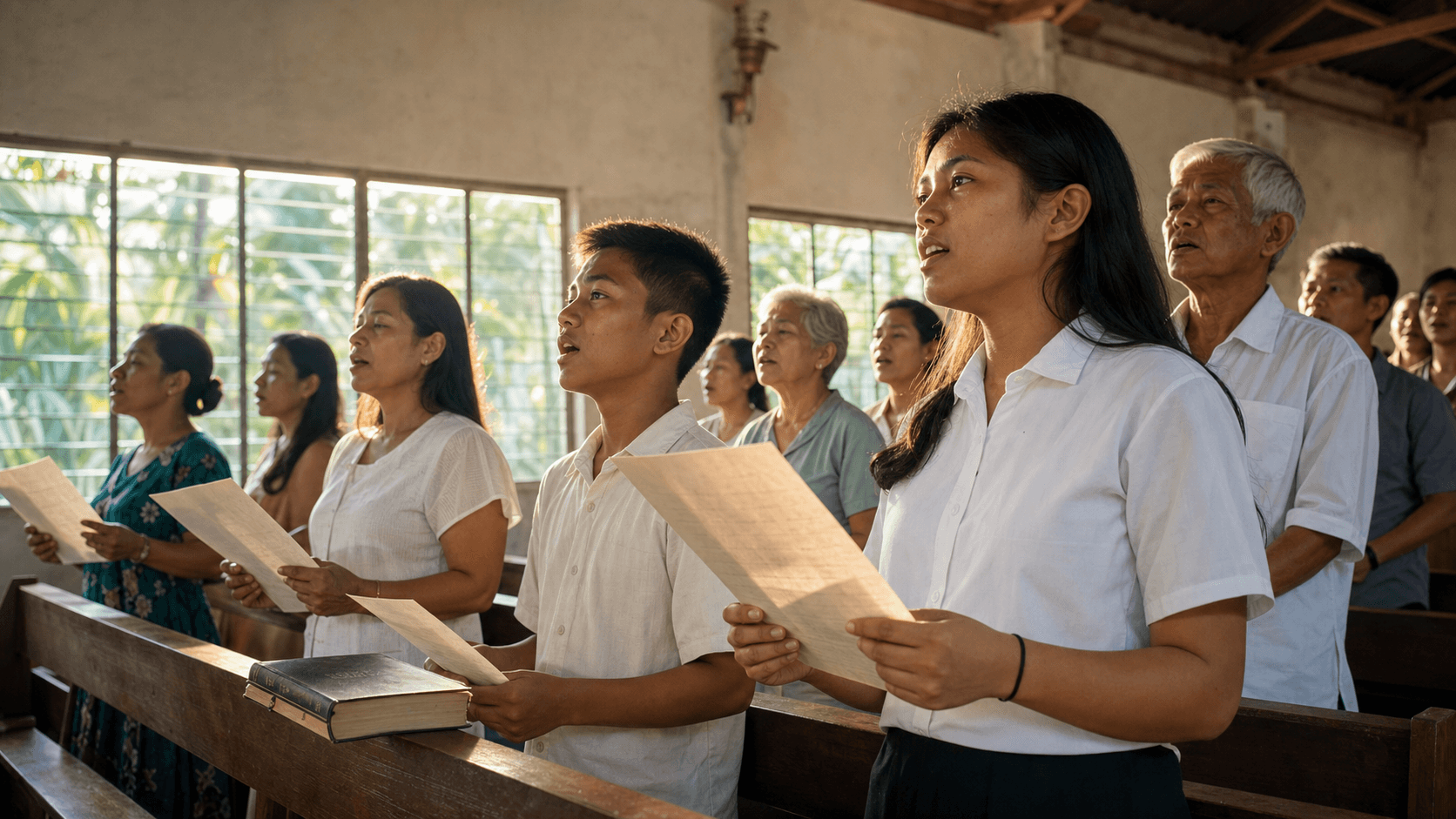
A word cloud can look simple at first: bigger words mean more songs contain them. But in this corpus, the biggest words are not just vocabulary. They are a map of what the community keeps returning to when it sings.
Across 295 cleaned Bisaya Adventist songs, the largest words include diyos, hesus, kinabuhi, ginoo, gugma, langit, kalipay, kaluwasan, and pagtuo. Put plainly, the songs keep circling God, Jesus, life, love, heaven, joy, salvation, and faith.
That already tells us something important. The emotional center of these songs is not vague positivity. It is a specifically Christian and Adventist hope, grounded in divine presence, salvation, heaven, and the promise that the present world is not the end of the story.
The word cloud is not merely showing what appears often. It is showing what the songs trust enough to repeat.
The Center Is God, Jesus, And Life
The top words are striking. Dios appears in 150 songs. Hesus appears in 137. Kinabuhi appears in 131. Ginoo appears in 81. Gugma appears in 77. Langit appears in 70.
Those numbers form a kind of theological sentence: God and Jesus stand at the center; life, love, heaven, joy, salvation, and faith gather around them.
This matters because it keeps the interpretation from becoming too generic. The songs are not merely cheerful. They are hopeful in a particular direction. Their hope has names, images, and destinations.
The most repeated vocabulary suggests that these songs are written to rehearse assurance. They remind the singer who God is, where life is going, and why faith is still worth holding.
Word-cloud signal
The largest words form a theological sentence.
The Songs Are Hopeful, But Not Naive
The top 100 words show a strong positive tilt. Positive words cover about 1,062 cumulative song-slots, while negative words cover 256. That is roughly a 4:1 positive-to-negative ratio.
At first glance, that might make the corpus sound almost too optimistic. But the phrase and context data complicate the picture. The songs are hopeful, yes, but they are not untouched by pain.
At least 169 of the 295 songs, about 57.3%, contain at least one suffering, sin, death, pain, or anxiety term. Pagsulay appears in 37 songs. Kasakit appears in 35. Kagul-anan appears in 25. Sala appears in 23. Kalisdanan appears in 21. Kabalaka and kamatayon each appear in 20.
So suffering is not rare. It is consistent enough to matter. The question is not whether these songs name suffering. They do. The deeper question is how they teach the community to view it.
Suffering register
Suffering is frequent enough to matter.
At least one suffering, sin, death, pain, or anxiety term appears in 169 of 295 songs.
How The Songs View Suffering
The clearest pattern is this: suffering is real, but temporary. It is painful, but answerable. It belongs to the present journey, but not to the final destination.
In the lyric windows around suffering terms, pain is often placed beside divine help, joy, trust, cleansing, or heaven. One line frames pain as something exchanged: ang imong kasakit ilisdan ug kalipayng hingpit. Another imagines heaven as the place where sorrow is gone: didto sa langit, wala nay kagul-anan, lunlon kalipay.
Trials are not treated as proof that God is absent. One window says, sa mga pagsulay siya ang mag-uban. Worry is not merely described; it is surrendered: isalig ang tanang kabalaka kay siya nagmahal kanimo. Failure is not final either; it is brought under Christ's blood: kapakyasan ... sa iyang dugo ka hugasan.
That is why the article should not describe the corpus as simple optimism. A better phrase is endurance theology. These songs name pain, but they quickly place pain inside a larger story of trust, cleansing, perseverance, Christ's presence, and heaven.
The Phrases Show Movement
The two- and three-word phrases make the argument stronger because they show how the big words are being used. They do not merely list doctrines. They create movement.
Diyos kauban suggests divine companionship. Igsoon padayon sounds like communal exhortation. Hesus mobalik and diyos mobalik point toward return and final hope. Gusto kag kaluwasan frames salvation as something desired. Kinabuhi labing bililhon treats life as precious. Kagul-anan lunsayng kalipay turns sorrow toward joy.
This phrase layer matters because it reveals the songs as pastoral speech. The songs are not just saying, God exists, heaven exists, suffering exists. They are saying: God is with you, keep going, Christ will return, salvation is offered, life is precious, sorrow will not last.
The vocabulary is therefore directional. It moves the listener from present difficulty toward promised resolution.
Phrase movement
The two- and three-word phrases turn vocabulary into motion.
Faith As A Journey Through Time
One of the more interesting insights is that these songs sound like journey songs. Words such as dalan, panaw, padayon, panahon, adlaw, unahan, katapusan, mobalik, and langit give the corpus a sense of movement through time.
The believer is not imagined as standing still. The believer is walking, waiting, enduring, choosing, preparing, and looking ahead.
That may be why heaven matters so much in the word cloud. Langit is not only a doctrine about the afterlife. In these songs, heaven functions as emotional geography. It is home, relief, reward, reunion, and the place where suffering loses its power.
The songs therefore become maps for surviving time. They locate the singer between present suffering and final restoration, between the troubled world and Christ's return, between weakness now and life forever.
What The Pattern Gives And What It May Lack
The positive insight is clear: these songs give a community courage. They preserve a language of God, Jesus, salvation, heaven, faith, and endurance. For people living with grief, poverty, anxiety, illness, temptation, or fatigue, that kind of sung hope is not decorative. It can be spiritual survival.
But there is also a careful critical insight. Because suffering is often resolved quickly into hope, the corpus may leave less room for unresolved grief, protest, silence, or extended lament. The data does not prove lament is absent, but it suggests that unresolved lament is not the dominant register.
That tension is worth naming. A church needs songs that say pain will end. It may also need songs that sit longer with the pain before resolving it. Endurance becomes deeper when it has permission to be honest.
Still, the strongest conclusion is hopeful. These songs do not deny suffering. They teach the community how to outsing it.
“These songs do not deny suffering. They teach the community how to outsing it.”